


ReelRush: Short Drama & Reels
Hami Liti
I tried ReelRush as a quick entertainment app built around short dramas, and its main appeal became clear almost immediately: it is designed to turn a few spare minutes into a small episode-watching session. Rather than asking me to commit to a long film or a full television episode, it places short-form storytelling at the center of the experience. That makes it interesting for people who enjoy cliffhangers, compact plots, and frequent returns to the same story.
The app comes from Hami Liti and sits in the entertainment category. It is free to use, aimed at Everyone, and supports devices running Android 7.0 or later. The current release is version 1.0.2, and the app has passed the ten-thousand-install mark. Those details make it feel accessible to a broad audience, especially anyone using an older Android phone who wants something lighter in commitment than a conventional streaming service.
My honest view is that its strongest idea is not simply offering short videos. It is the way short dramas fit into interrupted parts of the day. You can watch while waiting for an appointment, during a lunch break, or before going to sleep without needing to remember a complicated plot across a long viewing session. That convenience is also the app’s central limitation: if you prefer carefully paced, complete-length productions, the bite-sized format may feel too compressed.
Short dramas make small viewing windows useful
The defining capability here is access to a large collection of short dramas with new episodes arriving every day. I would not treat that as a replacement for every streaming app I already use. Instead, I see it as a separate viewing habit. Traditional services are better when I want a polished film, a long episode, or a carefully selected catalogue. ReelRush is more useful when I want to open an app without planning an evening around it.
The short format changes how I judge a story. In a full-length drama, a quiet scene can take its time. In a short episode, the opening has to establish the situation quickly, and the ending often needs to create enough curiosity to bring me back. That rhythm gives the app a naturally fast pace. It also means I should not expect every storyline to have the same room for character development that I would find in a longer production.
Related News

Why WhatsApp Messenger Still Makes Everyday Communication Feel Easy

Jurassic World: The Game Is the Better Dino Tycoon for Strategic Players

Threads in Real Life: Who Should Join, Lurk, or Leave

How SHEIN Turned Shopping Into an Endless Content Feed

How to Make Fortnite Feel Smarter on Mobile

Should You Switch to Microsoft Outlook on Mobile?
The daily-episode approach is particularly effective for viewers who enjoy a continuing thread rather than random clips. A new installment gives me a reason to return, while the small size of each viewing session keeps the commitment low. The real benefit is not just shorter video; it is a viewing routine that survives interruptions. I can stop after one episode without feeling that I have abandoned a major part of my evening.
That distinction matters when deciding whether to install it. Someone searching for background comedy, music videos, or one-off viral clips may not get the same value. The app is more focused than a general video platform because its attraction comes from serialized short drama. I would choose it for narrative momentum, not as an all-purpose replacement for every kind of entertainment.
What using it feels like in practice
My practical approach would be to open the app with a specific time limit in mind. Instead of scrolling indefinitely, I would choose a drama, watch an episode, and then decide whether the next cliffhanger deserves another few minutes. This simple habit helps preserve the advantage of short content. Without it, the low commitment of each episode can make it surprisingly easy to keep watching longer than planned.
Gallery
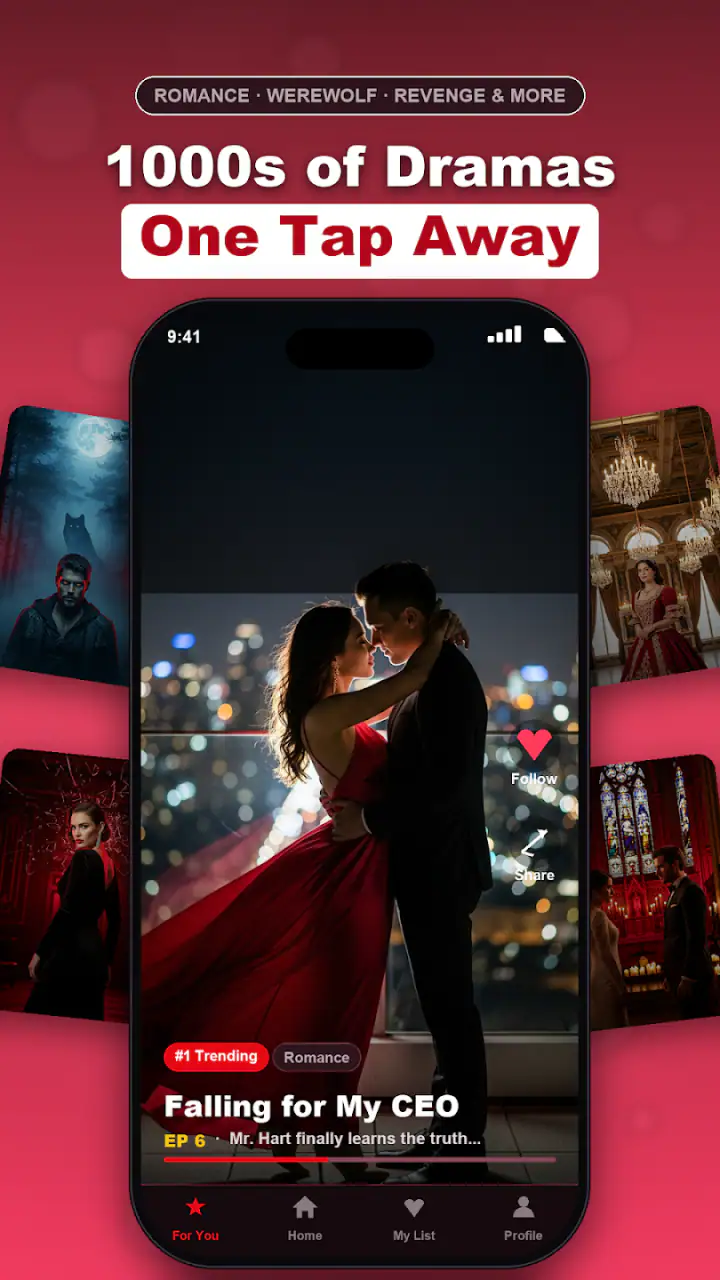
The daily release model also changes how I organize attention. If I am following more than one storyline, I would keep a small mental note of which plot I want to continue rather than opening the app with no intention at all. That is a useful strategy for short-drama platforms because several quick episodes can blur together when watched casually. A deliberate choice makes the experience feel more like following a series and less like endlessly sampling clips.
For a commute or waiting-room session, I would start with a stable connection and avoid beginning a new story when I know I will be interrupted immediately. Short episodes are convenient, but a dramatic scene ending just as I need to put the phone away can be more frustrating than satisfying. The format is at its best when I have enough time to finish one small unit, even if I do not have time for a full movie.
I would also judge the app after several visits rather than after one opening. Short-drama services depend heavily on whether the available stories match my taste. A single episode may not represent the whole catalogue, and the appeal often comes from discovering a storyline that suits my preferred mood. Giving the app a few focused sessions is a fairer test than expecting one random selection to win me over immediately.
A realistic everyday use case
Imagine arriving early for an appointment with roughly fifteen minutes to spare. A conventional streaming service might present too many choices, while a full episode could be difficult to finish. ReelRush fits that gap better: I can choose a short drama, watch one or more compact installments, and stop when my name is called. The story still gives the time some shape, unlike casually jumping between unrelated videos.
The same pattern works during a lunch break, but with one important adjustment. I would avoid starting a story at its most emotionally intense point if I know I need to return to work quickly. Short dramas are built to encourage continuation, so the ending may deliberately leave a question unresolved. That is enjoyable when I have a little breathing room, but it can be distracting when I need to switch immediately back to a task.
At home, I would use it as a bridge between activities rather than as my main evening entertainment. For example, after finishing dinner and before starting a longer program, a short episode can provide a quick change of pace. This makes the app complementary to mainstream streaming rather than directly competitive with it. Its value comes from filling small gaps that other services often leave awkwardly empty.
How it compares with familiar alternatives
Compared with a general video platform, the focused drama format is both a strength and a restriction. A broad platform gives me more variety, including tutorials, live content, music, and long videos. ReelRush should be easier to approach when I already know I want a short dramatic story, because the app’s identity points me toward that specific kind of viewing.
Compared with a conventional subscription streaming service, the free price removes a major barrier to trying it. I can explore the short-drama idea without making it part of a monthly entertainment budget. On the other hand, a paid service may offer a more established catalogue, longer productions, and a viewing experience built around films or standard television episodes. I would select between them based on the length and depth of entertainment I want that day.
Compared with social-media reels, short dramas offer a different kind of payoff. Reels are often designed for rapid discovery and immediate novelty. A drama asks me to remember a character or situation and follow what happens next. That small amount of continuity can make the viewing feel more rewarding, but it also means the app may be less satisfying when I only want completely random, self-contained clips.
The choice is therefore less about which app is universally better and more about the shape of the available time. If I have a free evening, I would probably choose a longer program. If I have scattered pauses and want a continuing story, ReelRush makes more sense. That is a clear niche, and the app benefits when it stays within it.
The tradeoffs behind the short-episode design
The biggest tradeoff is pacing. Short dramas need to move quickly, which can make them immediately engaging but sometimes less subtle. I may get a strong setup and a sharp ending without the slower scenes that help a character feel fully developed. Viewers who enjoy rapid twists will likely appreciate this structure more than people who prefer gradual storytelling.
Another tradeoff is the effect of cliffhangers on time. One episode can be easy to fit into a break, but the next episode may begin with an unanswered question that is difficult to ignore. I would treat the app like a snack rather than assume every session will remain tiny. Setting a stopping point before I start is practical, especially when I am using it during work or study breaks.
The free model is inviting, particularly for casual viewers, but free entertainment can be less predictable than a carefully curated paid catalogue. I would approach the app with an exploratory mindset rather than expecting every story to match my taste. That is not a deal-breaker for me, because the low entry cost makes experimentation easier, but it does make patience part of the experience.
Device compatibility is another quiet advantage. Support for Android 7.0 or later means the app is not limited to only recent phones. Still, older hardware can vary in how comfortably it handles video apps, so I would keep the device’s available storage and general responsiveness in mind. I would not install it on a phone already struggling with basic tasks without first checking whether there is enough room for another entertainment app.
I also would not recommend it to someone who dislikes serialized content. The daily-episode structure is central to the appeal, and a viewer who wants complete stories in one sitting may find the format unsatisfying. Likewise, people looking primarily for documentaries, sports, news, or long-form cinema should choose a service built around those needs instead.
Small habits that improve the experience
My first useful tip is to decide whether I am browsing for a new story or continuing an existing one before opening the app. Those are different moods. Browsing is best when I have spare time and curiosity; continuing is better when I have only a short window. Separating the two prevents the catalogue from consuming the entire session before I have watched anything.
My second tip is to judge a drama by its rhythm across several short episodes, not just by its first scene. The opening may be designed to grab attention, while the middle reveals whether the story can sustain interest. This is especially important with compact storytelling, where a dramatic hook can be effective even if the longer arc is not a good match for me.
A third practical insight is to use the app as a planned transition. I might watch one short drama after finishing a household task, before starting a workout, or while waiting for food. Giving it a defined place in the day makes the format feel intentional. Otherwise, the constant possibility of another episode can turn a useful break into unplanned scrolling.
I would also keep expectations realistic about emotional resolution. Short episodes are often more interested in continuation than closure, so I would not open the app expecting every visit to end with a complete conclusion. If I want a self-contained experience, I would choose a finished storyline when one catches my attention, but I would still assume that the app’s basic appeal comes from ongoing narrative momentum.
Who is most likely to enjoy it
ReelRush is a good fit for viewers who like dramatic stories but rarely have time for a full episode. It suits people who enjoy returning to a plot in small portions, discovering new series gradually, and using a phone for entertainment in short gaps. The free access also makes it easy for a curious viewer to test the format without treating the installation as a major commitment.
It may be especially appealing to someone who has grown tired of choosing between endless social clips and long streaming sessions. Short drama occupies the middle ground: it is more connected than random reels, but less demanding than a full-length program. That balance is the app’s clearest reason to exist, and it is where I found its most convincing everyday value.
I would be more cautious about recommending it to viewers who demand cinematic production, slow character work, or a carefully controlled catalogue. A standard streaming service may be a better choice for those priorities. I would also suggest skipping it if the idea of cliffhangers feels irritating rather than exciting, because the short-episode structure naturally encourages continuation.
Families may appreciate the Everyone age classification, but I would still make choices based on individual taste and maturity rather than treating an age label as a guarantee that every story will suit every viewer. The app is entertainment for a broad audience, not a promise that each drama will appeal equally to children, teenagers, and adults.
My recommendation after using the app
I see ReelRush as a focused companion for spare moments, not a universal streaming solution. Its daily short-drama approach gives narrative entertainment a practical shape: I can follow stories without reserving a large block of time. The free price and broad Android compatibility make trying it straightforward, while the compact format keeps the initial commitment low.
The decision comes down to what I want from watching. If I want an absorbing film, a complete episode, or a wide range of video categories, I would use a more traditional alternative. If I want a quick dramatic hook and the possibility of returning to it later, this app fits better. I would install it with a simple plan: try several stories, watch during clearly defined breaks, and keep the ones whose pacing genuinely works for me.
For my taste, the app succeeds when I treat its short episodes as a deliberate form of entertainment rather than as disposable scrolling. That is the key difference between finding it useful and finding it repetitive. ReelRush is worth trying if your day is full of small pauses and you enjoy stories that keep moving. It is less convincing for anyone seeking long-form depth, complete closure, or a single service for every kind of video.
FAQs for ReelRush: Short Drama & Reels
What is ReelRush: Short Drama & Reels?
ReelRush: Short Drama & Reels is an entertainment app focused on short-form video content. It combines brief, episodic dramas with reels and other quick videos designed for watching in short sessions. The app is aimed at users who enjoy fast-moving stories, dramatic scenes, romance, suspense, and social-style clips without committing to a full-length television episode or movie.
Is ReelRush: Short Drama & Reels free to download and use?
The app can generally be downloaded at no initial cost, but some content or features may require in-app purchases, subscriptions, virtual credits, or other payments. Availability can vary by region and account type. Before watching premium episodes or activating a trial, users should carefully check the pricing, renewal terms, and payment details shown in the app store or inside ReelRush.
Does ReelRush require an internet connection?
ReelRush is primarily designed for online streaming, so an active internet connection is normally needed to browse videos and watch dramas or reels. Performance depends on your Wi-Fi or mobile data quality. Streaming over cellular data may consume a considerable amount of data, especially during extended viewing sessions, so users with limited data plans should monitor usage and look for any download or offline-viewing options available in their version.
Is ReelRush suitable for children?
Parents should review ReelRush’s age rating and content information before allowing children to use it. Short dramas and reels may include romance, conflict, mature themes, advertising, user-oriented recommendations, or purchasing features. The exact material can change as new videos are added. If children use the app, parental controls, device purchase restrictions, and supervised viewing are recommended to help manage both content and spending.
What should I check before subscribing to ReelRush?
Before starting a subscription or purchasing credits, check which episodes and features are included, whether the offer is a free trial, how often billing occurs, and the exact cancellation procedure. Trials may automatically convert into paid plans if they are not canceled in time. It is also worth reviewing privacy permissions, account requirements, regional availability, and whether your preferred payment method will be charged automatically.
Pros
- Short episodes make it easy to enjoy during quick breaks.
- Frequent story updates keep ongoing dramas engaging.
- Vertical format feels natural on mobile screens.
- A broad mix of romance
- drama
- and suspense is available.
- Personalized recommendations can help discover new series.
Cons
- Many episodes may require coins or watching ads to continue.
- Some storylines rely heavily on familiar drama clichés.
- Frequent advertisements can interrupt the viewing experience.
- Video quality and subtitles may vary between different series.
- Offline viewing options may be limited or unavailable for some content.


